Product Overview:
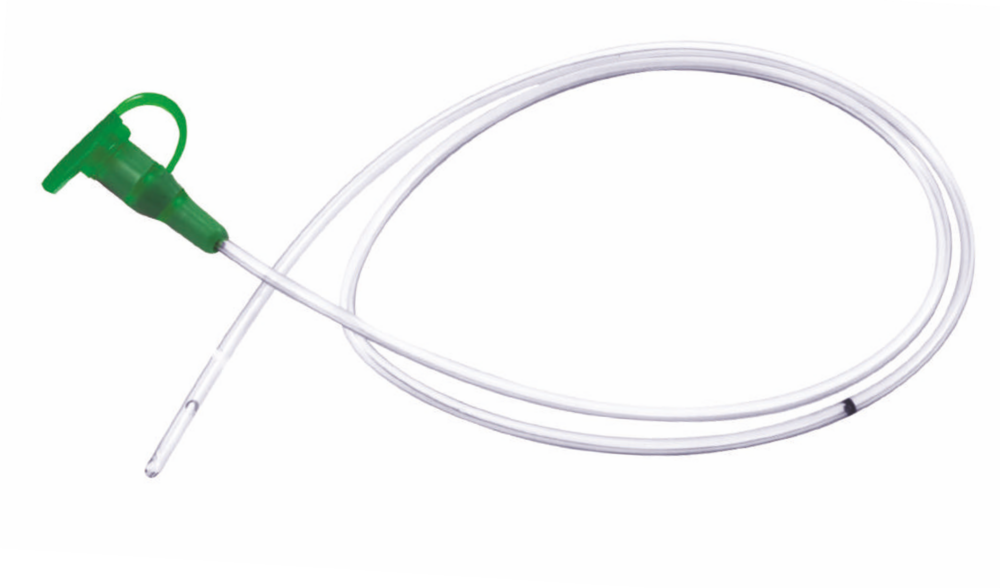
The Infant Feeding Tube is a sterile, single-use medical device designed for the administration of enteral nutrition, fluids and medications to infants who are unable to obtain adequate nutrition orally. It is a flexible, smooth and kink-resistant tube manufactured from soft, non-toxic, medical-grade PVC. The tube is inserted through the nose (nasogastric route) or mouth (orogastric route) and advanced into the stomach, depending on the clinical requirement and the healthcare professional’s judgement. It has a proximal funnel / female Luer mount for connection to compatible enteral feeding equipment and a distal tip coned with two lateral eyes, with a full-length radio-opaque line, to facilitate delivery of nutrition and fluids.
Infant Feeding Tube — flexible PVC tube with funnel connector, two lateral eyes and radio-opaque line
Key Features
- Manufactured from soft, non-toxic, medical-grade PVC.
- Distal end coned with two lateral eyes for effective delivery of feeds and fluids.
- Proximal funnel / female Luer mount for easy connection to a feeding syringe or set.
- Full-length radio-opaque line for radiographic confirmation of placement.
- Smooth, low-friction surface for easy introduction.
- Colour-coded sizes for quick identification.
- Available in a full range of French sizes (FG 4–10) for infants and neonates.
- Sterile (EO), pyrogen-free, latex-free and DEHP-free.
- Single use and disposable — do not reuse or re-sterilize.
Intended Use
The Infant Feeding Tube is intended for the administration of enteral nutrition, fluids and compatible medications directly into the stomach of infants who require assisted enteral feeding. The tube may be inserted through the nasal passage (nasogastric route) or through the mouth (orogastric route) by a qualified healthcare professional, and is intended for short-term enteral feeding and administration of fluids or medications, as clinically indicated. It is intended for use only by, or under the supervision of, a qualified healthcare professional trained in enteral tube placement and feeding, and is suitable for infants and neonates.